
Women In Pop, no. 17, November 2024
by Emma Driver •
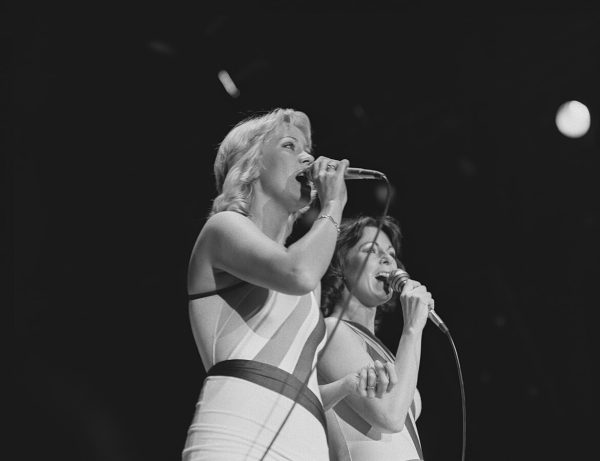
Fifty years ago, ABBA won Eurovision ’74 with ‘Waterloo’, led by those two exceptional women, Agnetha Fältskog and Anni-Frid (Frida) Lyngstad. Their win took the band’s fame from Sweden to the world, but it has always been the male half of ABBA that is credited as the genius behind their success, often leaving the creative contributions of Agnetha and Frida in the dark. Now, fifty years after their best-known success, it’s time to bring them into the spotlight once more.
• • •
Even if the Eurovision Song Contest generally passes you by as a yearly cultural moment, with its overachieving levels of spandex and emoting-to-camera, you may know one fact about it: that sometime in the 1970s, Swedish pop foursome ABBA won it. On 6 April 1974, at the Eurovision final in Brighton, England, the song ‘Waterloo’ rocketed them to fame not only in the Euro-territories but in far-flung Australia and across Latin America too. ABBA’s entry was announced with a defiant call for the audience’s musical attention: “My, my! At Waterloo Napoleon did surrender!” They had arrived, fully formed and not surrendering, already with a combined total of fifty years’ experience in singing, writing, producing and performing between them. With their gleaming boots in the doorway of worldwide fame, they were ready to leap on through.
Most of us can picture the two extraordinary women who grasped the reins in Brighton that night: Agnetha Fältskog, aged twenty-four, and Anni-Frid Lyngstad, twenty-eight, who we soon came to know simply as “Agnetha and Frida”. Visually, their high-sheen outfits and charmingly artless dance moves have since been imprinted, indelibly, into millions of brains, and the sound of their voices is unmistakable. After ‘Waterloo’ came a string of hits and favourites: ‘SOS’, ‘Mamma Mia’, ‘Fernando’, ‘Dancing Queen’, ‘Knowing Me, Knowing You’, ‘Take a Chance on Me’, ‘The Winner Takes It All’, ‘Super Trouper’, ‘Voulez-Vous’, ‘Chiquitita’ and more. ABBA scored nine number 1 singles in the UK and six in Australia, and ten of their albums topped the UK charts. In 2010, EMI Records presented them with an award celebrating 375 million singles and albums sold. Mamma Mia! – the musical and the films – has brought these songs to new generations.
How many people in the world can sing an ABBA song? Hundreds of millions? Billions? Today, the amount of ABBA audio data that lives collectively in brains worldwide can hardly be computed.
Agnetha and Frida’s role in choosing exactly how to launch those lyrics, melodies and harmonies into the world for maximum connection with their audience, drawing on their years of experience, is key to all of it. “Mostly we were standing in the studio right across from each other and just singing. There was so much singing. But for me it was not working. There was just fun,” we hear Agnetha say in the 2024 documentary ABBA: Against the Odds. Frida concurs, over footage of her and Agnetha leaning over a studio mixing desk, working hard: “You put your whole soul out there because it’s fun to give it your all.”
The male half of ABBA – Benny Andersson and Björn Ulvaeus – are rightfully renowned for writing and producing some of the best pop music ever made. ABBA songs are carefully crafted edifices, assembled brick by brick into a technicolour amphitheatre of surround sound, and the “B”s of ABBA deserve all the praise they get. But there is so much to be celebrated about Agnetha and Frida’s central importance in the making of those songs. So, with a blast of hooky ABBA-style brass, let’s take a quick trip through Some Things You May Not Know About Agnetha and Frida, and honour their place at the heart of the ABBA magic.
1. Before they were in ABBA, Agnetha and Frida were solo stars in their own right.
It’s easy to imagine that a band like ABBA, with few obvious musical precursors, sprang to life in a Big Bang–style moment, by accident, and that perhaps Agnetha and Frida became sequin-clad superstars overnight. Not the case: they both began their singing careers in the 1960s as talented teens – Agnetha in a dance band in southern Sweden, aged fifteen, and Frida in a schlager band, at thirteen. (Schlager is a province of European popular music that shares a border with “easy listening”, and it did big business in the 1960s: catchy singalong choruses, love-song lyrics often steeped in melancholy, and roots in traditional folk music.) Frida wasn’t even Swedish, originally. Born in Norway to a German father and Norwegian mother, she moved to Sweden as a child and was raised by her grandmother in small-town Torshälla, 150 kilometres west of Stockholm. She was married in 1964 to musician Ragnar Fredriksson, with whom she formed a jazz band and had two children.
In 1967, when Agnetha was seventeen, her band sent a demo to a Swedish record label, and on it was a song Agnetha had written, ‘Jag var så kär’ (‘I was so in love’). On the strength of it, she was offered a solo record deal, and the song became her first single the same year, soon followed by a self-titled debut album. Agnetha’s emotional vocal delivery is all over that schlager-shaded debut, and her elastic upper register is already soaring on tracks like ‘Jag har förlorat dej’ (‘I have lost you’) – a song whose lyrics she wrote. In fact, of the twelve tracks on her first album, Agnetha wrote or co-wrote nine. That Agnetha was a songwriter is often forgotten in the ABBA story. “I used to be more productive back then,” she said on Swedish talk show Skavlan in 2013. “I’m not the kind of songwriter who’s always writing songs.”
By the time Agnetha’s debut landed, Frida was making her way. She won Sweden’s Nya Ansikten (New Faces) TV talent show in 1967, aged twenty-one, and secured her own record deal with EMI. Her win came on an unusual night for Swedish TV-watchers. “Famously, the night that she won the talent show coincided with the day that Sweden changed the law about the side of the road that people drove on,” says English journalist Giles Smith, ABBA admirer and author of the funny and heartfelt book My My! ABBA Through the Ages. “People were not risking going out and driving, so an unnaturally large television audience was sitting at home, and Frida was rocketed to fame.”
Her first solo album came a little later, in 1971. Its jazz influences are clear, and her tone is light and seemingly effortless, suited to the lush orchestral arrangements of this adult contemporary collection. There’s a light operetta quality to her voice, a malleable instrument that sounds like it could take and mould any song in any genre. “By the time ABBA began, Agnetha and Frida were completely professional,” Smith notes. “They knew about going on stage. They knew about projection. And they knew about projection through television as well – they’d already done a lot of that, which is important to the ABBA story, because television was the way they would conquer the world.”
When Agnetha and Frida finally joined with Benny and Björn to form ABBA, the four morphed into what was, in Sweden, a supergroup, because Benny and Björn were already known to their fellow Swedes from their own bands: The Hep Stars (Benny) and Hootenanny Singers (Björn). The pair had met on tour in 1966, then joined forces to write together. By 1969, Björn had met Agnetha, and Benny had met Frida, and each couple had fallen in love (Frida’s first marriage had ended). They worked together sporadically: Agnetha had Björn as co-producer on her third solo album, Som jag är (‘As I am’), in 1970, while Frida brought on Benny as producer for Frida in 1971. Finally, the two halves joined into a foursome, though their first outing, as a cabaret act touring Sweden, was by all accounts a disaster. Yet those early days helped cement their working relationships for the wild times ahead.
Finally – finally – the ABBA template came together in the 1972 single ‘People Need Love’, for which they were billed as the less-snappy “Björn & Benny, Agnetha & Anni-Frid”. The track is much more folksy than their later releases, but some ABBA hallmarks are already in place: lyrics in English rather than Swedish; a catchy chorus, peppered with singalong syllables (“Na na na na …”); strong vocals from Agnetha and Frida, in harmony, in confident unison and in a counter-melody that weaves around the final chorus; and a burst of charming strangeness in the almost-yodelling in the closing bars. Musical oddities soon appeared all over ABBA’s work, as they tirelessly produced music to the beat of their own tambourine. As Giles Smith puts it, “They never sounded like their era. None of their songs could ever be accused of pursuing what was fashionable at the time.”
2. ABBA songs are really hard to sing, because Agnetha and Frida were supremely gifted vocalists.
There’s no point craftily layering an intricate pop song if you have no way of bringing it to life. For that, you need singers with the skill, stamina, consistency and singular presence to deliver it, or your brilliantly constructed song will have as much impact as a pebble dropping in outer space. And for an ABBA song, you need Agnetha’s and Frida’s voices: strong, strident, whisperingly gentle, trembling with vibrato, seemingly endless in vocal range.
An example: try out ‘Dancing Queen’ at a karaoke night. If you can sing as low as Agnetha on the verse – “Friday night and the lights are low” – you might feel your confidence grow. The first few notes of the chorus come around, and you’re still OK: “You are the dancing queen …” Then, uh-oh, it’s the high point of the chorus. You’re primed to “feel the beat of the tambouriiiine”, but it’s goodbye “singing” and hello “squeaking in the stratosphere”, if you’re lucky. There’s a jump in the melody of almost two octaves, and the high notes need to be sung with power and absolute conviction. Only the most fearless and naturally gifted amateur vocalist can pull it off.
“Take away Frida and Agnetha and let two other girls sing their parts, and ‘the ABBA sound’ goes out the window immediately,” Benny told author Carl Magnus Palm for his 1994 book, ABBA: The Complete Recording Sessions. “Their voices were simply the most important ingredient of our overall sound structure.” When Giles Smith came to re-listen to ABBA songs for his own book, this struck him too. “Those two women’s voices, both individually and together, are an immensely powerful pair of instruments. It’s a bit of a cliché to say, but it’s like there are three vocalists in ABBA: there’s each of them individually, and then when you put them together, it’s like a third voice.”
The power of their vocals, the stamina, built through their early work. Smith points out the evolution after early recordings like 1973’s ‘Ring Ring’, their first single release outside Europe. Overall, early ABBA songs flutter a little more lightly, not yet sure where to land. Step into 1974, though, and Eurovision’s ‘Waterloo’ comes bounding from the gates, announced by that decisive “My, my!” After singing in unison through the verse, their hiving off into harmony adds depth to the chorus, and Frida’s lower tones anchor Agnetha’s bright soprano on the next verse: “I tried to hold you back but you were stronger” – a line that acknowledges a relative weakness but punches out the words with paradoxical vocal strength.
Juxtaposing words of dejection with strident vocals was something ABBA always did to great effect. There’s ‘Mamma Mia’ and its “How can I resist you?” flung at the listener; the resignation of “There is nothing we can do” in ‘Knowing Me, Knowing You’, articulated in solid planks of harmony; and “Won’t somebody help me chase the shadows away?” in ‘Gimme! Gimme! Gimme! (A Man After Midnight)’, which might sound forlorn in its minor key if not for Agnetha and Frida’s delivery. As Björn is heard to say in the Against the Odds documentary, “Even if they sing very sad songs, together they sound somehow jubilant.”
If there is anyone apart from Agnetha and Frida who can shed light on what it’s like to deliver ABBA’s greatest hits to an audience, it’s the singers who take them on in top-shelf tribute acts. Donning the white polyester for Australia’s Abbalanche show are Joanna Walters and Stella McCoy, who know all the technical challenges and shoulder-wiggling joys of performing ABBA songs inside out.
“Agnetha makes things sound so effortless, even though they’re ridiculously hard,” says Walters, who tackles Agnetha’s role on stage. She namechecks ‘The Winner Takes It All’ as the gold standard of Agnetha vocals. “It’s a hard song, and most people, when they attack it, it’s as a big belting sort of thing. But if you actually hear her do it, it just sounds so easy. Those high notes are just coming out as if she’s talking. It’s from the training they must have had, the technique that they developed.”
And what about Frida? Agnetha’s soprano often takes the main melodies of ABBA songs – the ones most of us sing along to (if we can) when an ABBA hit enters our ears. But Frida’s vocals are just as demanding, sometimes more so, as they swoop above and drop below the melody. This is what Stella McCoy – Abbalanche’s Frida – quickly discovered when she had to learn the parts note for note. “Frida’s parts are just amazingly all over the shop! She goes so high, and weaves between everything,” McCoy explains. “You don’t really take it apart unless you’re trying to learn it, but all of those parts in the background – I don’t know if I ever assumed one person was doing the vocal gymnastics.” Frida’s low tones on songs like ‘Money, Money, Money’ are a key part of many ABBA songs too. Says McCoy, “I feel like it’s rare in female pop vocals to get to sing so low, but it still sounds melodic – you’re not waiting for somebody to jump in and reach the big vocal part. It’s so weighty.”
Agnetha and Frida, in interviews for Carl Magnus Palm’s The Complete Recording Sessions, went on record to say how much they loved their creative role in ABBA. “To participate in the creation of the songs and try to interpret them in your own way was the best part of being in ABBA,” said Agnetha. Still, Benny and Björn often pushed them to sing ever higher, to draw out the forcefulness of their voices – “almost beyond the limit of our voice ranges”, Frida remembered, although “nothing was impossible”. Recording vocals for each ABBA song would typically only take Agnetha and Frida just one day. In the hothouse environment of a recording studio, where repetition can suffocate even the strongest feeling, they were virtuosos in communicating emotions via lyrics that were not even in their first language. “Agnetha and Frida somehow seemed to be made for this job. They worked hard and energetically, and there was never any talk of ‘oh, not today, I have to feel inspired!’” ABBA’s longtime studio engineer Michael B. Tretow told Carl Magnus Palm. “They had an enormous amount of control over their own voices, and could do the most difficult things. It’s very unusual with singers who are able to sing with such precision and still sound convincing.”
It’s not just songs like ‘The Winner Takes It All’ and ‘Dancing Queen’ that are vocally demanding, either. Walters and McCoy nominate ‘Lay All Your Love on Me’ as an unexpected test of stamina. “A lot of Frida’s part is all on the same note, and you don’t really take a breath between those notes,” says McCoy. Walters agrees: “It’s always one that catches me a bit off guard. The chorus is really elongated. Literally the whole time, I am going, ‘I am so out of breath! I am so out of breath!’”
Björn also sang lead on some of the cornerstones of the ABBA catalogue – on ‘Rock Me’, for instance, and in his solo verses in ‘Does Your Mother Know’, although it can be argued, in the latter, that the song only kicks off when a wash of Agnetha and Frida elevates it to something we recognise as full-service ABBA, with all its interior detailing and polish. And all credit to Björn for knowing how to play second fiddle (vocally) to his band’s formidable female half. You almost get the sense that he was happy to provide a contrast, allowing our spirits to lift as soon as Frida and Agnetha slid into the driver’s seat.
3. In the studio, Agnetha and Frida were not simply told what to do. Their creative input was crucial.
Let’s leave this myth to Frida and Agnetha to sort out. “Björn and Benny are generally thought of as the geniuses behind the band, but all the creative work was really done in the studio,” Frida said in a 2018 interview with Swedish newspaper Aftonbladet. “We worked on all the details. All the harmonies. That often gets forgotten. The creative work took place in the studio, spread over many, many hours. A fantastic amount of joy and togetherness went into creating our sound.” Agnetha chimed in: “We did everything ourselves. It was a lot of work.”
They had already explained this for The Complete Recording Sessions back in the ’90s, when Agnetha had been adamant: “When you work as a producer yourself, like I have done, and spend that much time in the studio, you learn a thing or two. I know that I have contributed lots of ideas for arrangements, harmony parts, gimmicks, and solutions to several problems over the years.” Testing and refining harmonies was a collaborative process too, Frida recalled: “There was a lot of improvisation going on when it came to recording the harmony vocals. When you kept hearing the melody over and over again, you started getting these little ideas for a suitable harmony phrase … and if they worked we simply kept them.”
In her 2013 interview on Skavlan, Agnetha was asked if any member of ABBA was the “boss” of the band. “We were all bosses. We were all very strong people. Strong-willed people. That’s probably why things turned out so great.” And who would be the first to give in when push came to shove? Agnetha: “Not me, that’s for sure.”
4. Agnetha and Frida never hated each other. Tabloid journalists made that (and other things) up.
In the 1970s and ’80s, tabloid and gossip magazine reporters zeroed in on Frida and Agnetha and conjured gossip out of thin air. The Swedish press were notorious; by the early 1980s, Agnetha had made several official complaints to press regulators about false stories. But one of the most persistent ABBA-related rumours was that Agnetha and Frida hated each other. It was part of a long media tradition (still going) of imagining female singers squaring up to each other as if in a boxing ring – as if there just isn’t room for more than one female talent in any arena. Even in the 1990s, a very unauthorised ABBA book called The Name of the Game told tales of entrenched bitterness and infighting, along with some sexist commentary too grubby to quote.
Frida stood up to this in her 2018 Aftonbladet interview. “I would like to put the record straight on one thing,” she declared. “A lot has been written about how Agnetha and I fought and quarrelled with each other. There is absolutely no truth in that. Of course, we competed … but to good effect.”
“No, we didn’t fight,” Agnetha added. She also addressed this fight-club fiction in Against the Odds. “So much has been written that Frida and I are not friends. It’s not very fair to do that. We had a lot of fun, but we also helped each other.” They competed, she agreed, but in a healthy way: “A bit [of] competing is good because you really do your best.”
Relentless scrutiny is exhausting for anyone, as it must have been for Agnetha and Frida, especially when it belittled their talents. Cameras didn’t linger on Björn’s mouth as he mimed into a mic. Reporters didn’t grill Björn and Benny about their bodies, their sexuality or their literal bottoms – as in the infamous scene in 1977’s ABBA: The Movie, when an Australian journalist fronts up and says to Agnetha, “I read somewhere you are the proud owner of an award which declares you as the lady with the most sexiest bottom. Is that true?” Agnetha shoots back, “How can I answer to that? I don’t know. I haven’t seen it.” One headline in Sydney’s Daily Mirror tabloid, after ABBA’s first Australian concert in 1977, read: “Agnetha’s Bottom Tops Dull Show”.
Australian crassness that may have been, but in Europe Agnetha and Frida didn’t fare any better. In a German TV interview in 1976, an interviewer asks, “And what do the girls do in this whole thing?” Agnetha jumps in: “Nothing.” Everyone laughs. Benny clarifies: “They do the rest.” Are other lead singers routinely asked to justify their role? Did anyone ever say, “Hey, Ozzy Osbourne, what did you do in your band?”
“It’s painful to read what was written about Agnetha and Frida in the ’70s, particularly here in the UK,” says Giles Smith. “Frida in particular had a terrible time. There’s this notion that Agnetha is ‘the blonde and the beautiful one’, and Frida is ‘the other one’. There’s an awful concentration on her looks in a negative way, which is just so absurd. It would have been a lot for her to carry around, but she always seemed to be rising above it.”
And of course, rock journalists at the time were generally dismissive of, or downright rude about, sparkly Swedish pop, and the set-up of the band bothered them too: two couples, seemingly settled down, and therefore not sexually available. “In many ways there’s nothing more conventional than that,” says Smith. “It’s particularly interesting in relation to women in pop, I think. Here was a group that announced its unavailability directly. It seems to have irritated people – it certainly irritated rock critics.”
Consider, too, how difficult that environment must have been for the two women particularly, as their relationships with their husbands began to fracture and both pairs separated – very publicly – from the late ’70s. Imagine taking your relationship on an intense overseas tour where you’re holed up in hotels and herded into cars, without a minute’s respite from your partner. Smith’s take on it is that “the pressure on them, personally and within their relationships, must have been unbearable – and indeed it was unsustainable”. And yet, after the relationships ended, they kept the band going. “What’s amazing is just how grown-up they seem to have been about it, that refusal to really explode, which the watching world was keen to see happen in some rather ugly way.” Maturity, privacy, musical professionalism: Agnetha and Frida maintained all of this while cameras were trained on them, always probing for cracks that could be levered wide open.
• • •
Now, fifty years after their Eurovision triumph, ABBA’s legacy is more than intact – it’s bulletproof. No music critics would argue now, as they did in the ’70s, that ABBA produced throwaway, cynically marketed pop, destined to frothily float away while the ballast of serious rock and roll stayed put. Within those uncrushable songs and the spirit of ABBA, Agnetha and Frida were so much more than great singers in space-disco jumpsuits. They brought the music alive and communicated its energy as no one else could have done. The ambitious £140 million ABBA Voyage avatar spectacular in London understands this well as it recreates the sounds and visuals of the band’s heyday. The message? Don’t mess with the magic.
“There’s just so much joy in an ABBA concert and in their music,” says Stella McCoy. She and Joanna Walters recount stories of ABBA fans of all ages – from young kids to ninety-six-year-olds – at Abbalanche shows, singing every single word that they’ve learned from singing along with Agnetha and Frida. “The other night, we brought up on stage these two young girls to dance with us. They were doing every move with us in their seats – every move, and singing every song. And one of the girls goes, ‘I’m so happy!’ It was beautiful. It’s elating. And every time we perform, I still feel that way.”
Fans aren’t the only ones who turn to ABBA in times of need. “When my self-confidence is very, very low, it can happen that I put on ‘The Winner Takes It All’ or some other song and just feel … proud,” said Agnetha in 2013. “And I think, ‘Ah! I did this! No one can ever take this away from me.’”
• • •
Giles Smith’s My My! ABBA Through the Ages was published by Simon & Schuster in 2024. For all things Abbalanche, see abbalanche.com.au. •