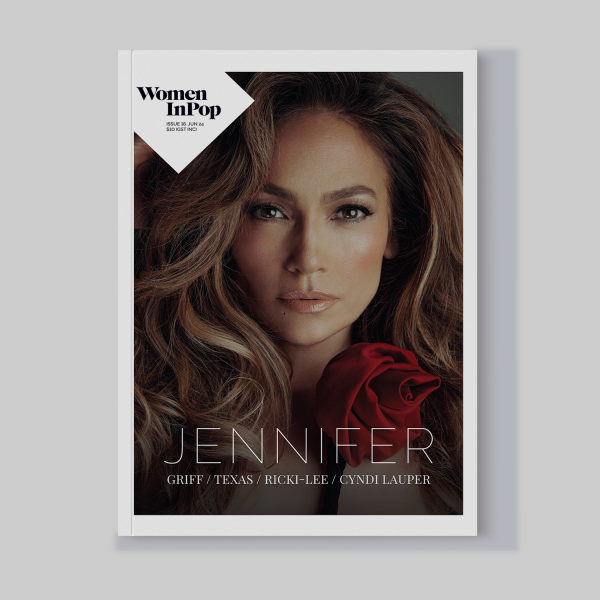
Women In Pop, no. 16, June 2024
by Emma Driver •
Forty years ago, Cyndi Lauper scored her first number 1 hit in America: the treasured ballad ‘Time After Time’, which would be the biggest hit of her career. But despite her brief top-of-the-charts success, Lauper’s career was far from over. This exceptional singer, songwriter, activist and fashion maverick has been exploring every corner of her musical imagination for more than fifty years – and she’s a long way from finished.
• • •
Say the words “Cyndi Lauper” to anyone with a passing interest in popular music, and one image should pop into their heads: the (literally) brightest star of the mid-1980s, rocking a vintage corset under a clatter of jewellery, or layers of iridescent charity-shop petticoats, with hair so bright it could be seen from space. They’ll also hear her distinctive, impossibly high voice, too, as ‘Girls Just Want to Have Fun’ suddenly worms its way into their ears.
By the time Cyndi Lauper had created her own mid-’80s cultural moment, she had already lived many lives: a kid who wanted to be an artist; a struggling, broke and often homeless teen; and a rockabilly frontwoman whose early bands nearly destroyed her voice. Then she became an award-winning songwriter, a soulful interpreter of other people’s work and the composer of a hit Broadway show, all while working as a passionate activist for human rights causes.
If we measure success in chart hits or albums sold, then Lauper had only a few years at the top. But that is the wrong way to measure this influential artist’s life and career. Never setting out to be a pop star, Lauper just wanted to sing however she could, creating performance art by marrying her voice with a totally original visual aesthetic. No one told the mid-’80s Cyndi Lauper what to wear, just as no one could tell her how to shape her career. She wanted to explore and discover for herself, and refused to jump onto a hamster wheel of hits written and controlled by someone else.
Lauper is that 1983 version of herself, the one that she created and lived. But it’s just a tiny part of the story of where she came from, and where she decided to go next.
Destined to be so unusual •
When ‘Girls Just Want to Have Fun’ crashed onto the airwaves – and TV screens – in October 1983, Cyndi Lauper was already a fully formed artist with a vision. It was her debut solo single, but she was no wide-eyed ingenue. At thirty years old, she’d seen enough to not take the opportunity for granted.
‘Girls…’ was an instant anthem, perfect for embracing the joy that life could offer, and for yelling along with at parties (because who else but Lauper can really hit those high notes?). Lauper received a demo of the song, written by Philadelphia-based songwriter Robert Hazard, during sessions for her debut album She’s So Unusual, but she wasn’t sure about it: its lyrics were written from a male perspective, and the “fun” of the title was purely sexual. So Lauper rewrote key lyrics to change the message altogether. “I edited it and moved a few things around, and put [in] a melody line … and sang it in a key where my voice would sound like a trumpet, because you’re trumpeting in an idea,” she explained in 2019. That idea was simple: freedom for women of all ages to be in control of their own destinies, and to have whatever kind of fun they actually wanted to have (not just some hetero guy’s bedroom fantasy of “fun”).
It’s hard to imagine an ’80s party dancefloor without ‘Girls…’, but some of the song’s early feedback wasn’t complimentary. One radio programmer told Lauper’s record label that it was “not an album-orientated song. It’ll never make it. It certainly isn’t top 40 – she sings way too high.” As Lauper said in 2019, she wasn’t bothered by the critique. “The people that are supposed to hear the idea – the girls, the women – will hear it. The gatekeepers – they’ll laugh, and you’ll get past them. And that’s all I kept thinking.”
Lauper carefully orchestrated the video and promo photos to match the song’s message, right down to every detail of her Wear Everything From The Wardrobe All At Once approach: “That’s why I had a chain on my ankle – [women] were still chained! Yeah, it was fashion [but] it went a little deeper.” As with most of her early videos, Lauper drew in friends and family: her mother Catrine is the mother in the clip; brother Butch plays the pizza delivery guy; friends made up most of the partygoers (one of whom wore her real nurse’s uniform); and even her lawyer appeared – the middle-aged, uptight-looking guy in a suit. The shoot was as chaotic and wild as it looked, produced on a tight budget. “I knew what I was doing, and I insisted on making sure that [the clip] was multiracial so that every little girl … could see herself in the video and know that she too was entitled to a joyful experience,” Lauper said in a 2013 interview. “And I was so nutty that I got away with it.”
She got away with it all the way to number 2 on the Billboard chart, and number 1 in Australia and across Europe – and in Japan, where Lauper found a sizeable and devoted audience. Unique and instantly recognisable, she looked like she was having the time of her life. She gave fans the space to be odd, to express their inner weirdness on the outside. It was an empowering message wrapped in a playful package, one that appealed to rebellious girls but was unthreatening to the older women who came to see her perform. “You know when I really flipped out? When I saw grandmothers, mothers and their kids, with their hair shaved back on the side, and even the grandmother had a little pink something in her hair,” Lauper said in 1986. “That was the weirdest thing, seeing all three generations, and that’s when I thought I did something really good.”
But Lauper wanted more than chart-toppers: she wanted to write, even if record labels expected women with big voices to sing other people’s songs. There were a few early chances for collaboration on She’s So Unusual – including on album tracks ‘She Bop’ (everyone’s favourite ode to masturbation) and ‘Witness’, which had started life as a demo for her previous band Blue Angel. Then, late in the sessions, she and keyboardist/vocalist Rob Hyman, of Philadelphia band The Hooters, teamed up to write one last song for the debut. In a matter of days they came up with ‘Time After Time’, Lauper’s biggest-selling hit to date.
“We had never written a song together. We kinda opened up to each other,” remembered Hyman in 2021. Lauper found the process easy. “We were able to take real-life things, real things that were really happening … and put ’em right in the song.” The final version of the track was essentially a demo. Instead of spending months on production, Lauper delivered almost immediately. “Her vocal was incredible,” said Hyman. “She was singing it and we were playing it for the first time. That’s such a rare thing to happen, and I know that communicates to people.”
In June 1984, ‘Time After Time’ hit number 1 in the US and went top 5 around the world. At the 1985 Grammy Awards, Lauper was nominated in five categories, taking home Best New Artist. She’s So Unusual made the top 5 everywhere from the US and Australia to Norway and Japan, and Lauper was finally singing for a living – something she’d wanted to do for more than a decade.
But if anyone thought this shiny new pop star intended to keep churning out hits, they were mistaken. Lauper had been steering her creative energies and wild imagination since she was a kid, and she wasn’t about to hand over the reins.
Girls just want to make records •
“I’m just an intense little motherfucker, what can I tell ya?” writes the wryly self-aware Lauper in her 2012 self-titled memoir. And she was intense long before she was famous. From her earliest years, Cynthia Ann Stephanie Lauper (soon to become Cindy, then “Cyndi” on a friend’s advice) imagined herself an artist. She sang constantly, played her favourite songs over and over on her record player, practised being interviewed and making acceptance speeches, and dreamed up a world far away from her life in Queens, New York. Her first musical loves included Broadway (The King and I was an early obsession), Barbra Streisand, Louis Armstrong and The Beatles.
When Lauper was five, her father departed the family, leaving wife Catrine with Cyndi, her older sister Elen and little brother Fred (known as Butch). Catrine remarried, but Cyndi’s stepfather threatened the girls and abused Catrine. Elen left home as soon as she could, and Cyndi knew she’d have to follow. Her mother wanted to protect her daughters but was living her own nightmare. Cyndi fled at seventeen to live with Elen.
For the next few years, the teenaged Lauper’s life unravelled. She left school and went to a fashion college but failed her courses, then tried to finish high school but failed again. She shifted around New York, played music in short-lived duos and bands, moved to Vermont for a year for an art program, and took on any job she could to survive – waitressing, receptionist, retail, hostessing at a Japanese bar, nannying, busking and even begging when things got desperate. Through it all, Lauper remembers singing all the time – whether people wanted to hear her or not. “There’s nothing as soothing as certain notes vibrating through your body,” she writes in her memoir. “High notes make me feel like I am soaring high above the fray, never looking back.”
Lauper’s first cover bands in the early ’70s played more rock and rockabilly than pop, and her role as a physically adventurous backing vocalist soon led to her promotion. “Make the girl in the back who sings good, and falls all the time, sing lead,” one band’s manager told them. Cue years of punishing gigs where Lauper sang like Janis Joplin one minute, Grace Slick the next, which took their toll. In 1977, aged twenty-four, Lauper lost her voice entirely. Doctors told her she’d never sing again. With rest and a new vocal coach, however, Lauper began to rebuild her voice, treating it like an expensive instrument. She carted hotplates and kettles to gigs to “steam” her voice, and began a routine of vocal exercises before and after every gig that she still follows today.
A breakthrough came with Blue Angel, a band with saxophonist/keyboard player John Turi, with whom Lauper began writing. They released a self-titled debut in 1980, a collection of rockabilly-pop originals full of bluesy sax breaks and New Wave vocal stylings as Lauper pushed her voice around its impressive range. Despite solid songwriting and up-tempo charms – like the infectious ‘Maybe He’ll Know’, later ramped up and re-recorded for the True Colors album – Blue Angel didn’t resonate with US audiences. The band got tangled up in a messy legal case against their former manager. In the wash-up, Lauper was declared bankrupt and the band disintegrated.
Despite having been scouted as a solo artist for years, Lauper always preferred fronting a band. However, Blue Angel’s demise left her open to possibilities. New partner Dave Wolff offered to manage her, and after meeting with various labels she signed with Portrait Records, an offshoot of major label Epic. She met producer Rick Chertoff, heard some demos by The Hooters that piqued her interest, and the She’s So Unusual dream team was on its way.
Kooky, clever and in control •
Every part of Lauper’s image had been genuinely hers from the beginning, yet that was just a fraction of who she was. The eccentricity was real, but artists (especially women) who are funny and “weird” in their work are often dismissed as “faking it” or lacking intelligence – or both. As music critic Ann Powers noted on NPR a few years ago, “Humorous songs, the wacky songs often made by women, are always suspected to be artifice or calculated.” This assumption isn’t true, of course: Lauper was reflecting her genuine personality, and she was intelligent and alert to the inequalities around her.
“We don’t know what to do with clever women, and particularly clever women who don’t appear the way we think clever women should appear,” says journalist and academic Dr Liz Giuffre, senior lecturer in media and music at the University of Technology Sydney. “Women are infantilised, and [the media] infantilised Cyndi Lauper because of her high-pitched voice. But she refused to change that and leant into it. She was very out and proud about saying, ‘Well, I don’t care what you think of me.’”
At the time, Lauper told anyone who’d listen (and plenty who didn’t) that she was a feminist; she wore the label proudly, which helped to broaden the conventional idea of what a feminist might look like. As Giuffre points out, Lauper knew “you could wear a ra-ra skirt and be an activist. You don’t have to scream like Janis Joplin. You don’t have to be punk like Patti Smith. She said, ‘This is my expression, and that is what makes it feminist, because it’s my expression and it’s the way I choose to do it.’”
She was also way ahead of her time, too, in calling out how female musicians were fed through the music machine in the 1980s. Journalists dreamed up a contest, pitting Lauper against Madonna: Madonna was sexy, Lauper was kooky, so surely it had to be a competition? Lauper refused to engage with it, telling journalists quite clearly that the comparison was pointless. “I was always very impressed by how Cyndi would respond, saying ‘We do different things,’” Giuffre notes. “She has always seemed very sympathetic to Madonna, too – if Madonna was said to be ‘overly sexual’, Cyndi would say, ‘Well, so what? Why can’t she be?’”
Lauper understood how a woman’s sexuality could be a source of power, and how this power made certain men uncomfortable. “If a woman feels sexual, she has as much right to being sexual as a man does,” she said back in 1986. The rampant double standard about how sexuality is expressed in music was something that had annoyed her for years. “The same women who complain about [Madonna] being sexual probably own tons of Rolling Stones records, tons of Prince albums. There’s been sexism since the beginning of time. A woman is a sex object when someone else makes her into that object.”
Giuffre calls the Madonna-or-Cyndi narrative “lazy journalism”. Imagined choices between male stars – Beatles vs Rolling Stones, Blur vs Oasis – have also been media fodder at different times but, as Giuffre points out, in an interview with male artists “it wouldn’t have been the whole story – because they’d be asking about the music”. Not so with women, whose music was so often swamped by personal gossip in the press. Lauper thought it was all “a political thing, to keep women in their place”, wedged into their “little categories”, as she summarised in 1994. She was never going to be discussed at the level of revered male pop chameleons like David Bowie or Prince, which of course she should have been. She could be compared only to other women, and Madonna seemed the easiest choice for a media angle.
Shining with truth •
She’s So Unusual brought Lauper a sudden rush of stardom that she says was “surreal”. “I’d walk into an event and people would be screaming at me the way I used to scream over the Beatles, ripping at my clothes,” she recalls in her memoir. Along with the Grammys and other awards, and the non-stop attention, Lauper sang an iconic solo in the USA For Africa single ‘We Are the World’, and undertook a 90-show tour across the US. Then it was time to record the follow-up. Rick Chertoff wanted to be sole producer but Lauper was determined to co-produce. Unable to agree, they parted ways, and as Rob Hyman was affiliated with Chertoff, he was out of the picture, too. The record label wanted another commercial hit, but Lauper was sceptical. “I didn’t want to write ‘Girls Just Want to Have Fun Part 2’ – because I was afraid if I did, I would be stuck there forever,” she recalled in 2021. She began working with new collaborators, searching for the magic anew.
Label pressure, along with health problems that landed her in hospital, made it difficult for Lauper to focus. Then close friend Gregory Natal died from AIDs, aged twenty-seven. Lauper found it impossible to shut out her overwhelming grief. So, when presented with a demo called ‘True Colors’, by writers Tom Kelly and Billy Steinberg, Lauper immediately felt she could sing it for Gregory, for his devastated partner and for anyone else suffering as an outsider. Lauper and her keyboardist arranged the song simply. “I sang the words almost in a whisper,” she recalls in her memoir. “If the sentiment is that strong, you can’t overdo it.”
The writers loved her arrangement. “Tom and I were both elated when we heard her record of it because it was so much more adventurous than our demo. She produced it and did a beautiful job,” Billy Steinberg told Songfacts. The song was quickly embraced by the LGBTQI+ community as an anthem of healing, as it remains today.
Less immediately catchy than She’s So Unusual, True Colors went deeper. Along with the title track, standouts include a cover of Marvin Gaye’s ‘What’s Going On’; ‘Boy Blue’, a song specifically written for Gregory; and the old Blue Angel doo-wop toe-tapper ‘Maybe He’ll Know’. True Colors may not have matched the sales of its predecessor, but it got to number 4 on the Billboard album chart in November 1986, and to date has sold some 7 million copies around the world.
Over the next few years, Lauper continued to evolve. Anyone could see the collision coming: her label, now owned by Sony, wanted hits, hits, hits, but Lauper wanted to produce and write and explore new territory. Sessions for her third album stalled while she starred in her first feature film, the screwball comedy Vibes, and her relationship with Dave Wolff fell apart. Still, Lauper knew she couldn’t avoid the recording studio forever. Attempting a more commercial feel, the result was 1989’s A Night to Remember. (“Which I call A Night to Forget because it was one of those albums destined to be doomed,” says Lauper, admitting that it was the result of a tug of war with her record label that nobody won.) It did have one hit – the Kelly/Steinberg song of yearning ‘I Drove All Night’ – but the album’s production damped down Lauper’s voice, at times burying it under a wash of adult-contemporary synths. A Night to Remember marked the end of Lauper’s time at the top of the mainstream charts, but it was nowhere near the end of her musical life.
The star also rises •
By the time Cyndi Lauper released her fourth album, 1993’s Hat Full of Stars, she had settled into a contented marriage to actor David Thornton, whom she’d met on the set of Off and Running, another film she’d starred in. And then Lauper took some time off to experience normal life again – because, as she notes in her memoir, “If you’re an isolated artist, what the fuck do you write about? How it’s really tough to live in an ivory tower?”
Writing again with Rob Hyman, among others, Lauper then put together a set of songs with a conscience that took on serious issues like domestic abuse, abortion and apartheid. Critics praised not only the thoughtfulness of Hat Full of Stars, but also the renewed power and range in Lauper’s voice. She was acting again, too; as well as Off and Running, she guested in several episodes of the sitcom Mad About You and won an Emmy in 1995.
Lauper carried on recording and touring through the ’90s too. The greatest hits collection Twelve Deadly Cyns … and Then Some in 1994 included an exuberant reggae version of ‘Girls Just Want to Have Fun’, and a year later came the eclectic Sisters of Avalon, exploring a bit of everything: European folk, indie rock, gentle acoustica and more. After releasing the joyous Merry Christmas … Have a Nice Life, Lauper capped off the decade with worldwide touring as Cher’s opening act on her Do You Believe? tour.
In 2003 Lauper turned to torch songs with the album At Last, rearranging classics like ‘Walk On By’ and ‘Unchained Melody’ into versions all her own. For her tenth studio album, Bring Ya to the Brink, she took off to Europe to tap into the high-key dance-pop of the clubs, topping the US dance/club charts with two singles. From her memoir, though, it’s clear that her view of working with Euro-dance producers like Max Martin was mixed. “Unfortunately, a lot of these guys never read the credits, so they didn’t know I’m a producer and an arranger and not just a singer, and they want to do it all,” she recalls.
Was there any genre left for Lauper to conquer? 2010’s Memphis Blues added straight-up blues to her catalogue, sharing credits with greats like singer Ann Peebles and guitarist B.B. King. Six years later she had country music in her sights on Detour, tinging her new arrangements of country classics with rockabilly and theatrical flair. Musical theatre? No problem. When she composed the music and lyrics for the musical Kinky Boots, which opened on Broadway in 2013, Lauper won a prestigious Tony Award for Best Original Score – the first time a solo woman had ever claimed the prize. Typically humble, Lauper insisted that she’d had no idea what she was doing, but the show’s veteran librettist and producer, Harvey Fierstein, couldn’t praise Lauper enough: “It’s a pleasure to work with someone who knows what she’s talking about,” he told an interviewer.

And there was always activism. Since the mid-’80s Lauper had been giving time and energy to AIDS campaigning and LGBTQI+ causes; her sister Elen is gay, and Lauper had seen the discrimination up close. In 2007 she set up the True Colors tour to raise awareness of discrimination, and a year later co-founded a charity to help young LGBTQI+ kids who were homeless. In 2022, as some US states began overturning laws that legalised abortion, Lauper started the Girls Just Want to Have Fundamental Rights Fund to support reproductive choice. Across all her causes, Lauper’s charity work has gone far beyond the “splash the cash and walk away” model of many celebrity philanthropists. She has consistently put her money, time and energy where it’s needed, and was subsequently awarded the United Nations’ High Note Global Prize in 2019.
Even knowing all this, we might still associate Cyndi Lauper predominantly with her ‘Girls Just Want to Have Fun’ era: the clothes, hair and trumpeting voice, her charismatic skip-jump-lurch style of dancing. You get the feeling that Lauper wouldn’t mind in the slightest – that image was her creation, and she’s always embraced it. But it’s not anywhere near the whole picture of this complex, talented and adaptable artist. She was not a pop star who dropped out of the ’80s hit machine to wander off into has-been land. As Liz Giuffre puts it, Lauper “came and went” from the height of mainstream success, but that was because she grew and changed: “Is that reinvention? Is it growing up? Is it ambition? Is that saying ‘fuck you’ to the music industry? It’s probably all those things.” And it meant Lauper didn’t buckle under a mountain of pressure to stay at the top. She just moved on.
Lately Lauper has been working on another Broadway show and performing internationally, including a slot at the UK’s Glastonbury Festival in June; last year she toured with Rod Stewart, contributed to a documentary about her life and sang on Cher’s first Christmas album (“I called Cyndi first,” Cher says). This year Lauper announced that she has sold some of the rights to her music to Pophouse, the company started by ABBA’s Björn Ulvaeus, and plans to collaborate with them on an “immersive theatre piece” about her life and the women in her family.
“Music will always change … there’ll always be an upstart that changes it,” she observed in 2011. “For young girls who are coming up, there’s gonna be more and more and more. You can’t stop us – we’re still coming.” No doubt Lauper, with her tireless creative instincts, will continue to seek out new ways to support other artists and to evolve in her own music for as long as she can. And, unlike many icons in their ivory towers, she’ll do it all while paying close attention to the world outside her door. •