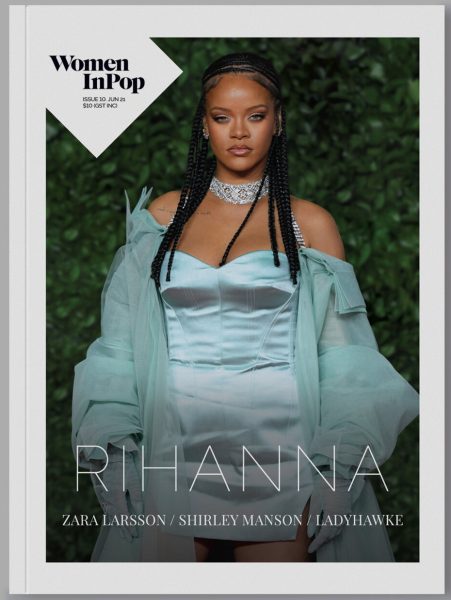
Women In Pop, no. 10, June 2021
by Emma Driver •
Carole King’s solo album, Tapestry, released in 1971, is still beloved by women in pop – fans include Lady Gaga, Adele and Taylor Swift. Yet while King had already been a successful songwriter, co-writing some of the biggest hits of the ’60s, she almost didn’t take the solo path. So how did this trailblazer find her mojo and create this iconic album?
• • •
In the 1990s, when Taylor Swift was a kid living in Pennsylvania, her parents would play Tapestry, the second solo album by American singer and songwriter Carole King, in the family home. It was one of their favourite records: they had loved it back in the 1970s, and two decades later the magic rubbed off on their daughter.
So, when Swift accepted the Artist of the Decade honour at the American Music Awards in 2019, it was just right that a beaming Carole King was there to present Swift with the glittering prize. “I cannot believe that it’s Carole King, it’s you!” Swift gasped. “When I fell in love with music, it was right around the time I realised how marvellous it was that an artist could transcend so many different phases and changes in people’s lives. So you taught me that that’s a possibility.”
Katy Perry, performing at a charity tribute to King’s music in 2012, had pinpointed something similar. Tapestry, she said, was an album of “songs that cover all bases”. No matter what you’re feeling, she said, there’ll be a song on Tapestry to fit that mood, whether “you want to dance, or you want to cry”.
This relevance to so many states of heart and mind is a big part of the album’s appeal, and a big reason it’s a favourite of a hugely varied slice of humanity, from US presidents (Barack Obama is a fan) to your next-door neighbour. Songs like ‘I Feel the Earth Move’, ‘(You Make Me Feel Like) A Natural Woman’, ‘You’ve Got a Friend’ and ‘It’s Too Late’ are known widely and loved deeply. Flashy they are not: there’s no pitch tuning, no complex digital tinkering. These are recordings of Carole King playing piano and singing with her band in a room, and it still feels like she is speaking to every one of us directly.
It’s no wonder, then, that back in 1971, Tapestry travelled straight from the ears to the hearts of listeners, then to their feet as they rushed to record stores in vast numbers. The album sold an estimated 7 million copies worldwide in its first year alone; that figure is now around 25 million.
Tapestry hit number 1 on the charts in the United States, Canada, Japan and Spain; number 3 in Australia; and number 4 in the UK. It won four Grammy Awards for 1971: Record of the Year and Song of the Year (the first time either had been won by a woman), plus Album of the Year and Best Female Pop Vocal Performance. In 2020, Rolling Stone bumped it up to number 25 on its 500 Greatest Albums of All Time list, beating critics’ favourites like Bob Dylan’s Blonde on Blonde (no. 38), The Beatles’ White Album (no. 29) and Patti Smith’s Horses (no. 26). King, now considered a national treasure in the US, was inducted into the Songwriters Hall of Fame in 1987 and the Rock and Roll Hall of Fame in 1990, and has won more lifetime achievement awards than she could possibly fit in the trophy room.
And even now, Tapestry endures. “People still connect with Tapestry,” says Esther Hannaford, the musical theatre star who performed the role of Carole King in the Australian production of Beautiful, the musical about King’s life. “I speak to young people and they’ll say, ‘I don’t know who she is,’ and I name a couple of songs, and then they say, ‘Oh my god, yeah!’ And people are still covering her songs.” Katy Perry pointed to the same quality. “Tapestry is so timeless,” she said. “I really look up to [King] as a songwriter and aspire to have the same type of career.”
• • •
The story of King’s fruitful career, and of Tapestry itself, goes back to the 1950s when New York teenager Carol Klein decided she was going to be a hit songwriter. As a kid growing up in Brooklyn, she had been obsessed with playing the piano, and spent countless focused hours trying to replicate the pop hits she heard on the radio. Her mother, Eugenia (Genie), taught her piano; her father, Sid, a New York City fireman, encouraged her musicality and loved to brag to his friends about her.
A bright student, Carol had first set her heart on becoming an actor, but after a year at a performing arts high school in Manhattan she dropped out, enrolled in a regular school and began performing with classmates in a doo-wop singing group, and soon began arranging their vocal parts and writing songs. In 1957 at age fifteen she took herself and her songs to the offices of Atlantic Records in New York.
The response was promising, but at label ABC-Paramount it was even better: she was signed for a three-year contract as Carole (with an “e”) King, where she recorded four of her own songs. The recordings led nowhere, and King says she made no money at all, but the experience gave her an early taste of what was possible in this exciting new world of pop.
In 1958 she graduated from high school, aged sixteen (she had skipped a grade), and at Queens College in New York she met Gerry Goffin, nineteen, who was determined to work as a lyricist in the city’s buzzing songwriting scene. They began writing together on the day they met, Goffin on lyrics and King on music, and soon fell in love. Then, after marrying in 1959, they signed a contract with music publisher Aldon and began writing in earnest – and, importantly, got paid an advance they could actually live on. What followed was an incredible eight or so years of writing some of the biggest pop hits of their day.
Their first number 1 was ‘Will You Love Me Tomorrow’, a hit for The Shirelles in 1960; the single was the first ever US chart-topper by an African-American girl group, and the first to be released on a female-owned label, Scepter Records (owned by entrepreneur Florence Greenberg). In the lyrics, Goffin channelled the thoughts of a young woman wondering if she should sleep with her boyfriend, unsure whether he truly loves her. The Shirelles reportedly disliked the song when they first heard King’s demo – “too white”, they thought – but when they were played the percussive, painstakingly crafted string arrangement that King had written for the track, they quickly changed their minds. It’s still one of the most distinctive parts of the record.
The early 1960s were King and Goffin’s peak: ‘Take Good Care of My Baby’ (Bobby Vee), ‘Crying in the Rain’ (The Everly Brothers), ‘Up on the Roof’ (The Drifters), ‘Chains’ (The Cookies, also recorded by The Beatles), ‘One Fine Day’ (The Chiffons) and ‘I’m Into Something Good’ (Herman’s Hermits) are among their best known hits from that era. There was also ‘The Loco-Motion’, first recorded by “Little Eva” Boyd in 1962, who was a vocalist as well as King and Goffin’s babysitter for a time. The track got its famous makeover in 1987 when Kylie Minogue released it as her debut single.
There were a few other female songwriters around the famed Brill Building songwriting district in New York where King and Goffin were based. Other trailblazing women were Ellie Greenwich (co-writer of ‘Be My Baby’ and ‘River Deep, Mountain High’, among others) and Cynthia Weil (‘You’ve Lost That Lovin’ Feelin’’), also working in husband-and-wife teams. But King would go on to be the most productive of them all.
Yet King didn’t write any lyrics – not yet. Instead, she was a masterful melody writer and arranger who could see possibilities in Goffin’s words and envelop them in some of the catchiest, most singable tunes around. King reputedly worked so fast that each song would be completed almost before the ink had dried on Goffin’s lyric sheet. It’s hard to imagine how unusual she was, now there are so many stellar piano-playing female composers in pop to choose from – Lady Gaga, Fiona Apple, Regina Spektor and Freya Ridings are just a few. But that was not the way pop was done in the 1960s.
The story of King’s musical life in that era intertwines with the changes brought by the women’s liberation movement, but they also reveal King as something of an anomaly, an original, in her professional path. When her songs with Goffin started taking off, she was still a teenager. “She was so young to train like that – to work like that,” Esther Hannaford points out. “She was living in New York, and there’s the pulse of that city, it’s very fast. It’s still mind-boggling to me that she achieved all that, especially at that time, as a woman.”
But by the mid-1960s, with young daughters Louise and Sherry to care for, King found her relationship with Goffin falling apart, in part due to Goffin’s enthusiasm for the ’60s counterculture and the drugs that went with it. For all her musical successes, King still thought of herself primarily as a mother and a wife, and she had been living within those expectations. “When I held Louise, vacuumed, and commented on a lyric Gerry was working on from the comfort of his armchair, it never occurred to me that I had a right to expect my husband to participate equally in child care and housework,” King reflected in her autobiography, A Natural Woman. “He might have been more helpful had I asked, but I didn’t know enough to ask.”
Musically, too, their relationship wasn’t always ideal: they had established a pattern of working that produced hits but did not necessarily deliver King any trust in her own talents. Eventually the pair separated, Goffin moving to California, and King soon doing the same, packing up her life and starting afresh in Laurel Canyon, Los Angeles, in 1968.
For King, the separation was difficult, but the move was life-changing. There, surrounded by musicians and writers, a new King emerged, as did new collaborators who helped to sow the seeds that would eventually become Tapestry. She began joining up with other musicians and playing for fun for the first time. Her jamming buddies in the late ’60s would become the core of her band on Tapestry: guitarist Danny Kortchmar would play on King’s next few albums, and they reunited for concerts in the 2000s, while bassist Charlie Larkey became her second husband, and the father of her third and fourth children.
It was a female lyricist, Toni Stern, who opened King up to the simple, confessional style of songwriting that would give King the impetus to write her own lyrics and form the bedrock of Tapestry. “I had been so intimidated by Gerry’s gift, his intellectual capacity, his skill, and his success that I could never bring myself to show my lyrics to anyone,” King wrote. “I found Toni’s more subtle form of guidance somewhat liberating.” They began writing together in the late 1960s and, within a year or two, King was ready to put pen to paper for herself.
In 1968, she recorded an album with Kortchmar and Larkey, in an outfit they called The City. They’d been signed to LA-based Ode Records by Lou Adler, and King had already made clear she couldn’t go on the road to promote the release. Commercially it wasn’t a success, but Adler then signed King as a solo artist, and she released her first solo LP, Writer, in 1970. It also flew under the radar, mostly due to King’s stipulation that she wouldn’t tour to promote it or do any interviews that might have pushed up its sales. Family was too important; she feared performing; and stardom held no appeal.
“I viewed success and stardom as two different things,” she wrote. “Successful recording artists were played on the radio, were respected by the public, and had longevity. The songs they sang moved and inspired people. Stars were hounded and mobbed, their privacy was non-existent, and they were under constant pressure to reach #1 and stay there … I’d rather be number five, or even number ten, and stick around longer.”
But something shifted that year. King had played piano on the breakout album by singer/songwriter James Taylor, Sweet Baby James, and Taylor convinced her to play some tour dates with him. King and Taylor had become good friends – Taylor described them as like “twins separated at birth” in a 2010 interview, and King agreed. King said yes to the shows, as long as she could take breaks to be with her children. One night, at King’s own former college in New York, Taylor encouraged her to sing lead on ‘Up on the Roof’, the old King/Goffin hit for The Drifters that she had recently re-recorded. Her performance was an unqualified success, breaking open her reluctance to take centre stage, and she went on to perform as the support act for Taylor in late 1970. She was finally ready. “I had found the key to success in performing,” she later reflected. “It was to be authentically myself.”
• • •
King recorded Tapestry over two weeks in January 1971, in Studio B at A&M Studios in LA. She wasn’t the only female artist in residence: The Carpenters were recording their third album next door in Studio A, while Joni Mitchell was working on her most successful album, Blue, in Studio C.
For King’s sessions, the piano was always in the middle of the room so she could direct the band with a nod of her head. There were candles and incense in the studio, and mood lighting that changed depending on the track. King also credited the guidance of producer Lou Adler as central to the studio sessions. He supported the integrity of each song and the simplicity of the arrangements, and had the crucial ability “to give his artists a safe space in which to be creative”, she wrote in her autobiography. This is no small thing in the male-dominated culture of the recording industry; historically, safe spaces for female artists were very hard to find.
King herself was both the beating heart and gifted mind behind Tapestry’s success. She knew instinctively how to wrap a complex yet killer tune around a lyric, then build up an arrangement to show it off without losing the song’s foundation. Her life experiences and her proficiency as a writer, singer, arranger and pianist fed directly into every track. The core of Tapestry is well-crafted, singable pop that is more honest, more unvarnished, than anything King had written before it.
Opening track ‘I Feel the Earth Move’, a King solo composition, announced (via its thumping piano chords) a joyous sexual liberation that spoke directly to women. American cultural historian Judy Kutulas has written about its revolutionary aspect: “Few songs so effectively expressed the upside of the sexual revolution from the female perspective, with its promises of unbridled joy and physicality,” she wrote in The Journal of American History. “The focus is on the feelings and experiences, not the lover.” It may not sound so revolutionary today, with the liberated, female-first sexuality of Megan Thee Stallion and Cardi B’s ‘WAP’, or Janelle Monáe’s ruffled pink vagina pants to compare it to, but to the modern ear it still sounds like an unashamed confession of lust.
Another of Tapestry’s enduring songs is ‘It’s Too Late’, with lyrics by Toni Stern. “There was hardly an under-thirty soul in the Western hemisphere … who couldn’t hum at least a few bars of ‘It’s Too Late’,” wrote a Washington Post commentator in the 1970s. It opens with the line “Stayed in bed all morning just to pass the time” – instantly relatable – and goes on to explore the petering out of a relationship without blame or acrimony. “Still I’m glad for what we had / And how I once loved you,” King sings, in reflective mode.
Romance wasn’t the only theme, either; there really was something to twang everyone’s heartstrings on the album. Second track ‘So Far Away’ is a plaintive meditation on being absent from home; Amy Winehouse loved it, and it was played at her funeral. ‘Home Again’ covered similar territory – missing home and loved ones left behind. Then there was ‘You’ve Got a Friend’, also a hit for James Taylor the same year, a stirring argument for loyalty and empathy in friendship. Addressing a friend in crisis, under a sky that “grows dark and full of clouds”, King sings: “Keep your head together and call my name out loud / And soon you’ll hear me knocking at your door.”
The King/Goffin songs ‘Will You Love Me Tomorrow’ and ‘(You Make Me Feel Like) A Natural Woman’ – the latter a catalogue-defining hit for Aretha Franklin in 1967 – also made appearances, in stripped-back piano renderings that brought their rousing melodies to the fore. King knew she wasn’t a vocalist like Aretha (“Q: How do you follow Aretha Franklin?” she wrote. “A: You don’t. You only precede her.”). Yet King’s voice had a vulnerability and naturalness that reflected the song’s title and made her listeners feel she was a woman singing about real, universal experiences that matched the tenor of the times.
Then there is ‘Where You Lead’, a not-exactly-feminist song about following a lover wherever he may go, no questions asked. Its lyrics, by Toni Stern, lagged a little behind the times even back then, King admitted in her autobiography. “Toni’s original lyric had taken a ‘stand by your man’ approach,” she wrote. “By the time that song was released on Tapestry in 1971 the lyric was already outdated.” Still, Barbra Streisand’s cover of the song made the US top 40 in 1971, and it got a pitch-perfect makeover in 2000 as the theme for US TV show Gilmore Girls – Toni Stern updated the lyrics to reflect a mother/daughter relationship, and King’s daughter Louise shared vocals with her mother.
The gospel-leaning ‘Way Over Yonder’ is a hopeful tune about finding paradise in a nature, with lyrics by King, and the raucous ‘Smackwater Jack’, a King/Goffin co-write, is a rollicking story song about a gun-happy outlaw. ‘Beautiful’ is a life affirmation set to music, a rousing exhortation to “get up every morning with a smile on your face” and let inner beauty shine through. Title track ‘Tapestry’ sees King meditate on the passing of time and the swinging pendulum of fortune.
Two months after Tapestry was released, it entered the Billboard 200 album chart. When it climbed to number 1, it stuck there for fifteen weeks. Overall it spent 318 weeks on the charts – the equivalent of more than six years (it exited and re-entered the chart over time). Not only was Tapestry a global success for King personally, it also paved the way for other female singers and songwriters looking to tell authentic stories. These were the early days of the American singer-songwriter boom of the 1970s, which saw women like Joni Mitchell, Laura Nyro and Melanie Safka make their mark.
Second-wave feminism was also foregrounding women’s experiences in new and exciting ways, and the album’s reception heralded a change to the way “women’s music”, and women as listeners, were viewed more widely in the music industry. As Judy Kutulas notes, “Tapestry helped to demolish traditional assumptions about women and popular music. Following its success, record companies and radio programmers could no longer believe that the female audience counted for less, and that its notions of love were girlish, romantic, and virginal.”
Tapestry even pleased some mainstream male music critics, who understood its unpretentious power. “The simplicity of the singing, composition and ultimate feeling achieved the kind of eloquence and beauty that I had forgotten rock is capable of,” wrote Rolling Stone’s Jon Landau in 1971. “Carole King reaches out towards us and gives us everything she has. And this generosity is so extraordinary.”
Even now, Tapestry still reverberates powerfully through popular music, influencing everyone from veteran rocker Steven Tyler of Aerosmith to the youngest generations of pop singers. (In 2019, then-23-year-old Norwegian singer Sigrid namechecked King as an artist she’d like to collaborate with.) While in places a little 1970s-esque (the jazz-inflected bass runs, for instance), Tapestry’s production sounds far less dated than other pop of the time that veered into prog-rock territory, or the meandering melodic structures of experimental folk. The sentiments King expresses and the language she uses aren’t padlocked to the era either: love, sexual freedom, hope, empowerment and longing aren’t specific to any time or place. And there’s no hip ’70s jargon in the songs that excludes a modern audience from hooking in.
King’s vocals still speak directly from every song – her voice has vulnerability at times, but it also has power, so much so that in 2011 Adele said she preferred not to call herself a “singer” because “my interpretation of a singer is Etta James and Carole King and Aretha Franklin”. Esther Hannaford agrees on King’s vocal power, and she knows more about it than most, having performed as King in Beautiful hundreds of times during its 2017–18 Australian run. “Carole King has got a strength to her voice – that’s her natural sound, and she makes it sound really easeful,” she says. “I have to really work hard to build up the strength to be able to make that sound easy. You have to do workouts to get to her level of punchiness.”
Hannaford has revisited King’s work with her recent Tapestry 50th anniversary show around Australia, where she sang the album in its entirety each night. For her, the magic of the songs is both their simplicity and their intricacy. “[King] just captured these base human emotions like love, and relationships, and the connection you have with other human beings,” Hannaford says. “I can’t imagine a world where those sentiments change.”
Yet while those emotions may be instantly recognisable, King’s compositions are anything but simple. “The songs sound very simple, but there are so many challenging curveballs she throws in there too. It’s challenging,” Hannaford admits. “They’re also really complex musically, and you don’t hear that, really, until you start pulling the songs apart. It sounds like such a chill record – and then you sing it!”
• • •
Post-Tapestry, King continued to write and record. Her follow-up, Music, sold 2 million copies, and for the next six years all her album releases achieved gold or platinum status in the US. Nothing she released after Tapestry reached the same level of commercial success, but King wasn’t bothered in the least. Having co-written some of the biggest hits of the 1960s, she had royalties as a steady income stream, and she’d never wanted stardom anyway.
“People often ask me if I was disappointed when subsequent albums didn’t do as well,” King wrote. “Some are skeptical when I say no. But I never expected Tapestry to achieve the success it did, and I saw no reason to expect that level of success to continue.”
King’s life after Tapestry included moving to a remote part of Idaho with her partner and two of her children, where they lived without electricity and were often snowed in for months at a time, then buying a ranch and launching herself into environmental activism and political campaigning for the US Democratic Party – while still flying back to LA to make records during the 1970s and ’80s. She may not have had another Tapestry, but she used the respect she had earned in ways that reached much further than selling out concert venues – which, until the global pandemic reared its head, she was still doing.
Tapestry is a product both of King’s musical prowess and her lived experiences. Her writing skills, her band, her uncovered confidence in lyric writing and her newly minted self-assurance on stage all coalesced to make Tapestry such a classic. “I found it fascinating that so many people thought that Carole kind of sprang from her own head with Tapestry,” King’s friend and fellow songwriter Cynthia Weil observed in 2019. “They didn’t know this part of her life which was so formative for her as a writer. She had such a rich history and she had contributed so much before Tapestry, and that was the culmination of so much of the work that she had done before.”
The last word should belong to King herself. In her autobiography, she reflected on the legacy of her most famous album with humility. “Hearing years later from people who grew up in countries around the world about how much the album had meant to them was something I couldn’t have imagined,” she wrote. “Whatever the reason, I’m thankful that I was given this uncommon opportunity to create something that touched so many people in a positive way.” •